Fragments of Living: The Poetry of Robert Frank’s Visual Diaries
In 2013, Michail Mersinis, a tutor in the Fine Art Photography Department at the Glasgow School of Art, sent an email to Robert Frank. The email was written on behalf of Mersinis’ students and requested a ‘donation of words' that could be included in that year’s class exhibition catalogue. In his email, Mersinis made mention of an impassioned discussion that arose during a class lecture the week before. The discussion revolved around Frank’s seminal 1989 work, ‘Hold Still, Keep Going.’ Much to everyone’s surprise, a few weeks later, a reply came for ‘a donation of words:’
Your familiarity with my work suggests that you understand that I have long run out of words. I am left with only photographs now. To satisfy the urgency of your letter and the care that your letter on behalf of your students suggests, please tell them this: Tell them to make work that is close to their heart. It seems to me that no one can expect more than this. I hope this is enough.
Regards,
Robert
Make work that is close to your heart. This simple notion seems to me to be the prevailing spirit that runs throughout most, if not all, of Frank’s work. This is especially evident in a recent series of publications, collectively known as the ‘Visual Diaries’, that Frank has been making in close collaboration with his long time publisher Gerhard Steidl. The most recent, Was Haben Wir Gesehen / What We Have Seen, was published earlier this year. Frank was born in Zurich, Switzerland in 1924 and moved to New York City in 1947 with a portfolio of photographs in the hope to make a new life. He quickly found work at Harper’s Bazaar, which enabled him to travel, first around Peru and Bolivia, followed by a brief return to Europe, where he travelled around Spain and France in 1949. It was in Paris that Frank first met with Robert Delpire, the acclaimed French publisher that would later publish Les Américains in 1958. In New York City Frank struck up friendships with the poet Allen Ginsberg, writers Jack Kerouac, William S. Burroughs, and others of the Beat Generation, which would have a lasting impact on his work. Much like Kerouac and his novel On the Road, Frank is best known for The Americans. This iconoclastic publication’s legacy still reverberates to this day, made almost sixty years ago, it has influenced generations of photographers and artists, people such as Ed Ruscha, Nan Goldin, Duane Michals and JH Engström, to name but a few.
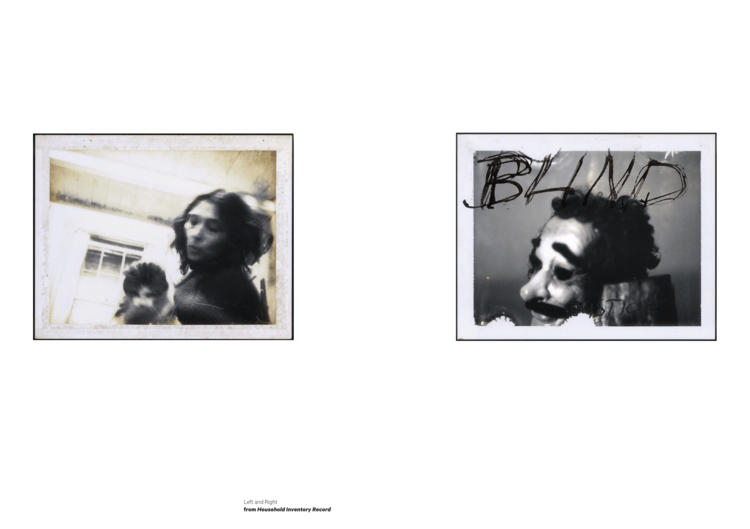
In 1959, Frank put down his Leica and picked up a movie camera and began making films, beginning with Pull My Daisy, a half hour short film written and narrated by Kerouac. Frank would spend the majority of the next decade working on film projects until the publication of his next major bookwork, 1972’s The Lines of my Hand. This book heralded a different kind of revolution in picture making – Frank’s photographs from this period are much more direct, poetic, and deeply personal. Working with a Polaroid camera and pack film, Frank scratched and painted words and phrases over the images, giving the photographs a tactile immediacy and tacit emotional depth. Throughout The Lines of My Hand, we are faced by powerful, singular works in which Frank has taped, nailed, or glued images and text together; filmstrips are combined with still images and printed or pasted together on boards and scrawled over. It is in this work that we see, for the first time, what will become the central themes of Frank's work. His mantra of never looking back is belied by the fact that the first half of the book dredges through the earliest part of his career. The Lines of My Hand is very much a book in two halves--the inclusion of early photographs from London, Paris, Spain, Peru, and iconic images from The Americans in the book’s first half serve only to emphasise the dramatic shift in style and tone of the pictures in the book’s second half.
The post-1970s aesthetic may have been informed not just by the dramatic changes in locale, from Bleecker Street to rural Nova Scotia, but by a number of personal tragedies. The death of his close friend Danny Seymour, with whom Frank collaborated on a number of his early films, had a profound effect on him. This was followed shortly thereafter by the death of Frank’s daughter Andrea in 1974. Andrea, along with his son Pablo, were Frank’s only children born out of his first marriage to artist Mary Frank. Andrea was killed in a plane crash in Guatemala at aged twenty-three, and the wealth of works addressed or dedicated to his daughter is testament to her passing’s impact on Frank. His son Pablo, who had battled with drug addiction and mental illness for many years, took his own life in 1994, aged just forty-three. His relationship with his son was fraught, and a number of film works in which Pablo featured testify to this: The films Conversations in Vermont (1969), Life Dances On (1980), and Home Improvements (1985) clearly demonstrate the difficult, often strained relationship between father and son and the deterioration of Pablo’s mental and physical well-being. The diaristic mode Frank adopted as a film and picture maker at this time is evident throughout his later work.
Frank’s charged articulation of his own life and family form the visual diaries that have been published since 2010. Publisher Gerhard Steidl worked closely with Frank on these books, as well as on a number of classic book reprints. Frank and Steidl have forged a trusted working relationship which has culminated in this new series of bookworks; beautiful, small paperback volumes that have been published almost annually since 2010. The first volume was Tal Uf Tal Ab, in which Frank combined previously unseen photographs from his extensive archive with photographs made in recent years.
Tal Uf Tal Ab is Swiss-German. It means direction up the valley – down the valley. Now I live and wait and think mostly in the places I live – New York and Nova Scotia.
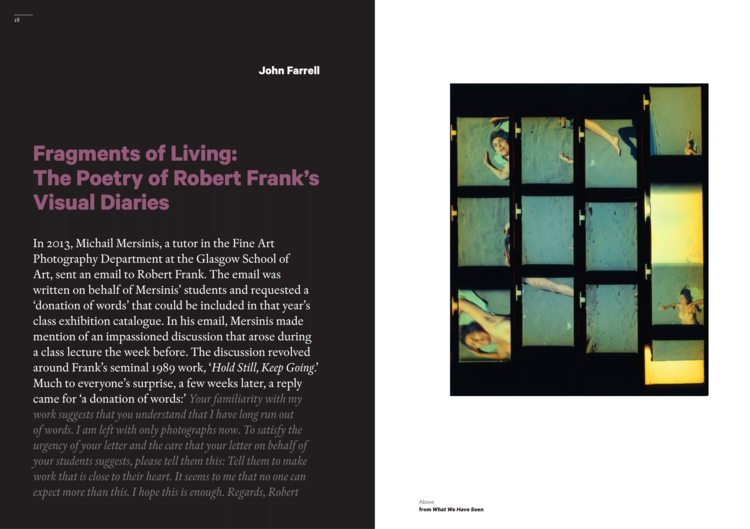
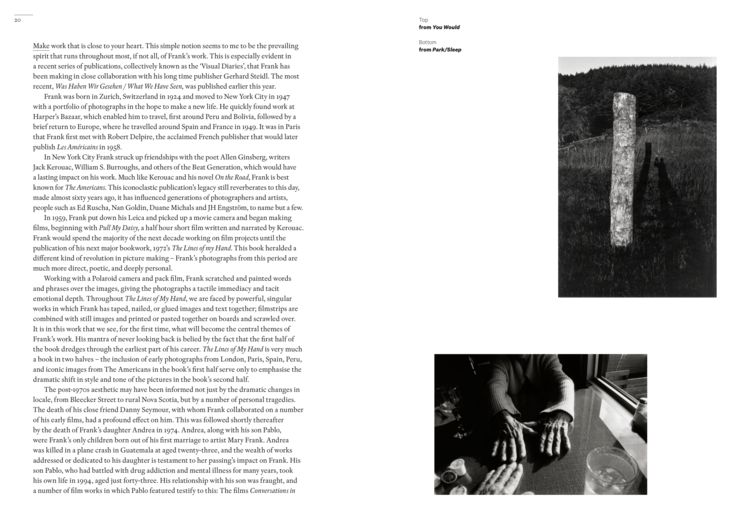
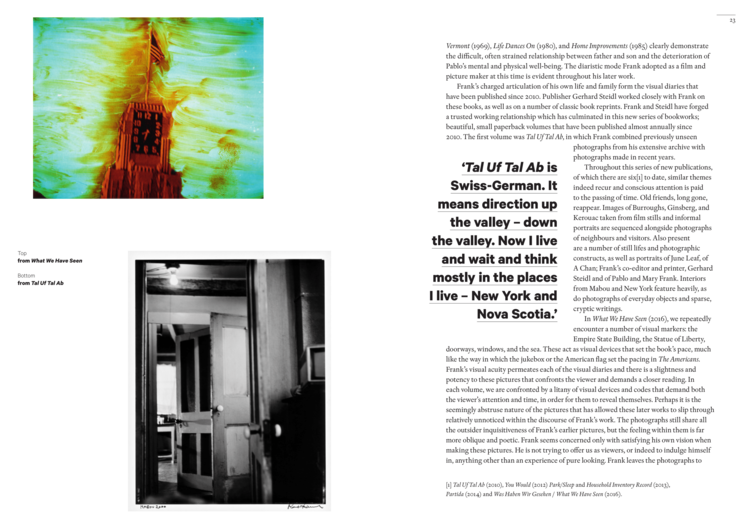
Throughout this series of new publications, of which there are six [1] to date, similar themes indeed recur and conscious attention is paid to the passing of time. Old friends, long gone, reappear. Images of Burroughs, Ginsberg, and Kerouac taken from film stills and informal portraits are sequenced alongside photographs of neighbours and visitors. Also present are a number of still lifes and photographic constructs, as well as portraits of June Leaf, of A Chan; Frank’s co-editor and printer, Gerhard Steidl and of Pablo and Mary Frank. Interiors from Mabou and New York feature heavily, as do photographs of everyday objects and sparse, cryptic writings. In What We Have Seen (2016), we repeatedly encounter a number of visual markers: the Empire State Building, the Statue of Liberty, doorways, windows, and the sea. These act as visual devices that set the book’s pace, much like the way in which the jukebox or the American flag set the pacing in The Americans. Frank’s visual acuity permeates each of the visual diaries and there is a slightness and potency to these pictures that confronts the viewer and demands a closer reading. In each volume, we are confronted by a litany of visual devices and codes that demand both the viewer’s attention and time, in order for them to reveal themselves. Perhaps it is the seemingly abstruse nature of the pictures that has allowed these later works to slip through relatively unnoticed within the discourse of Frank’s work. The photographs still share all the outsider inquisitiveness of Frank’s earlier pictures, but the feeling within them is far more oblique and poetic. Frank seems concerned only with satisfying his own vision when making these pictures. He is not trying to offer us as viewers, or indeed to indulge himself in, anything other than an experience of pure looking. Frank leaves the photographs to speak for themselves. That there is little to no captioning of his work, save for the occasional name of a person or place, reinforces the importance placed on the pure visual experience.
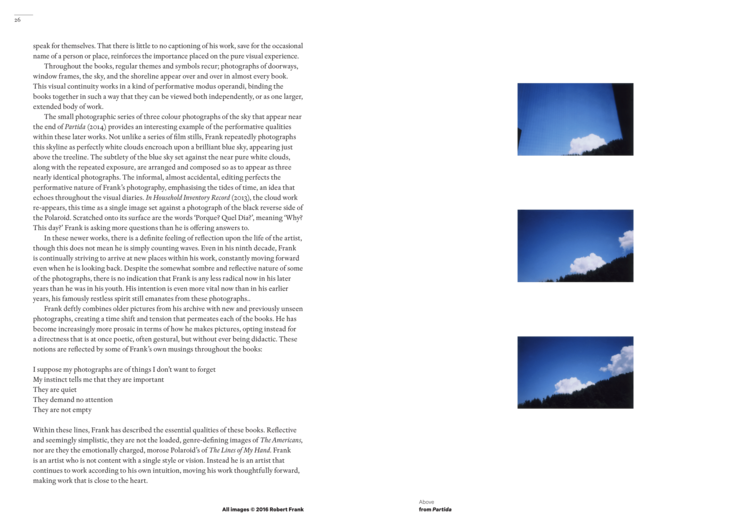
Throughout the books, regular themes and symbols recur; photographs of doorways, window frames, the sky, and the shoreline appear over and over in almost every book. This visual continuity works in a kind of performative modus operandi, binding the books together in such a way that they can be viewed both independently, or as one larger, extended body of work. The small photographic series of three colour photographs of the sky that appear near the end of Partida (2014) provides an interesting example of the performative qualities within these later works. Not unlike a series of film stills, Frank repeatedly photographs this skyline as perfectly white clouds encroach upon a brilliant blue sky, appearing just above the treeline. The subtlety of the blue sky set against the near pure white clouds, along with the repeated exposure, are arranged and composed so as to appear as three nearly identical photographs. The informal, almost accidental, editing perfects the performative nature of Frank’s photography, emphasising the tides of time, an idea that echoes throughout the visual diaries. In Household Inventory Record (2013), the cloud work re-appears, this time as a single image set against a photograph of the black reverse side of the Polaroid. Scratched onto its surface are the words ‘Porque? Quel Dia?’, meaning ‘Why? This day?’ Frank is asking more questions than he is offering answers to.
In these newer works, there is a definite feeling of reflection upon the life of the artist, though this does not mean he is simply counting waves. Even in his ninth decade, Frank is continually striving to arrive at new places within his work, constantly moving forward even when he is looking back. Despite the somewhat sombre and reflective nature of some of the photographs, there is no indication that Frank is any less radical now in his later years than he was in his youth. His intention is even more vital now than in his earlier years, his famously restless spirit still emanates from these photographs..
Frank deftly combines older pictures from his archive with new and previously unseen photographs, creating a time shift and tension that permeates each of the books. He has become increasingly more prosaic in terms of how he makes pictures, opting instead for a directness that is at once poetic, often gestural, but without ever being didactic. These notions are reflected by some of Frank’s own musings throughout the books:
I suppose my photographs are of things I don’t want to forget
My instinct tells me that they are important
They are quiet
They demand no attention
They are not empty
Within these lines, Frank has described the essential qualities of these books. Reflective and seemingly simplistic, they are not the loaded, genre-defining images of The Americans, nor are they the emotionally charged, morose Polaroid’s of The Lines of My Hand. Frank is an artist who is not content with a single style or vision. Instead he is an artist that continues to work according to his own intuition, moving his work thoughtfully forward, making work that is close to the heart.
[1] Tal Uf Tal Ab (2010), You Would (2012) Park/Sleep and Household Inventory Record (2013), Partida (2014) and Was Haben Wir Gesehen / What We Have Seen (2016).