Looking for the Edges: Ambit Photographies from Scotland 2019 exhibition review for SSHoP

Looking for the Edges: Ambit Photographies from Scotland 2019

Ambit: Photographies from Scotland is a collaborative exhibition between Street Level Photoworks (Glasgow) and Stills (Edinburgh); Scotland’s two dedicated centres for photography. Both venues have enjoyed landmark anniversaries in recent years, with Stills celebrating their 40th anniversary in 2017 whilst Street Level are gearing up to celebrate their 30th anniversary later this autumn and it is fitting that these celebrations are punctuated by this joint-exhibition. Given the turbulent political climate we currently find ourselves in, Ambit is deliberately internationalist in its outlook - any artist who chooses to make their life and practice here in Scotland is embraced with open arms. It is an important point of distinction that this is a survey of contemporary photography from Scotland rather than an exhibition of contemporary ‘Scottish’ photography, per se. Just as many would like us to close ourselves off from our European neighbours, Ambit serves as a reminder of the important cultural contribution made by those who have chosen to make these islands their home. This is perhaps most obvious at Street Level Photoworks where each of the exhibiting artists has direct links outwith Scotland, and indeed some of the artist’s address this tension directly.

Other White by Polish-born, Glasgow based artist Edyta Majewska is a powerful, emotive installation born out of her own experiences and anxieties about life in Post-Brexit Britain. Like many Eastern European nationals living in the UK, Majewska has experienced the racism and xenophobia that Brexit has given rise to. Taking the referendum vote as her starting point, Majewska filmed herself cleaning the polling booths at the school where she worked on the day before the vote; meanwhile Nigel Farage’s ‘victory’ speech fog horns in the background. Alongside is a collection of family snapshots made throughout her fourteen-year stay in the UK. Majewska transforms these vernacular images into a set of sprawling, hypnotising wallpapers pasted to the gallery walls - the true content of which only reveal themselves under the scrutiny of a magnifying glass. There are also incidental polaroid snapshots made by the artist and those close to her, each bearing a note from its maker - messages of hopes, fears and sobering realisations of what might yet come to pass. Other White addresses the duality and anxiety of being a foreign national in an increasingly dis-United Kingdom head on. Safe to say, the cruel irony of preparing the polling place where her future would be decided; without her say so, has given rise to an important and powerful body of work.
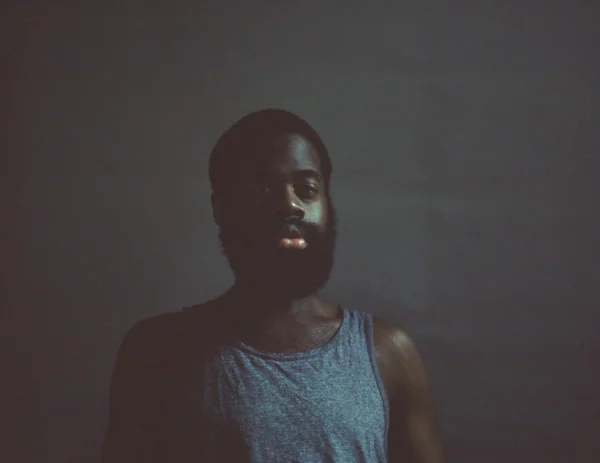
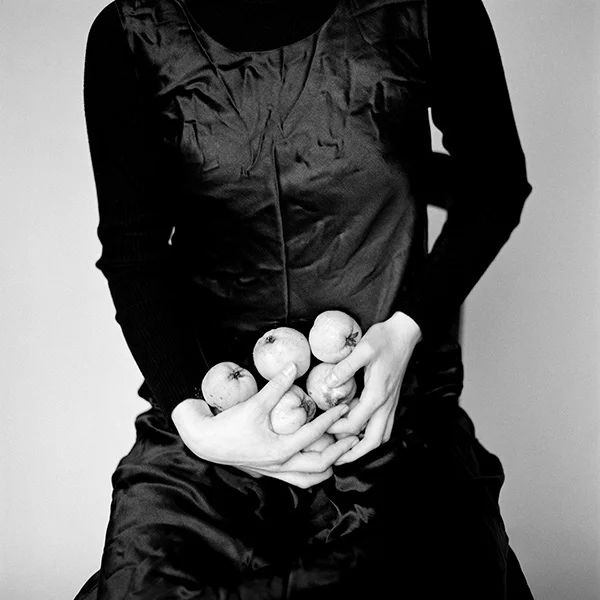
Alienation and hostility are themes shared in the work of Matthew Arthur Williams. In Conflict is an ongoing collection of subtle and often fragmentary portraits; borne out of the experience of being defined as ‘other’ - an experience shared between the artist and his sitters. This act of othering is drawn across many lines, be that of race, gender, sexual orientation or religion. Williams’ delicate photographs articulate this through his performative series of still lifes and portraits of peers, often obscured or merely glanced by his lens. This performative approach and sense of mystery is shared in Katy Hundertmark’s Studies in Gravitation; also on show Street Level. Hundertmark’s self-portraits were made during a prolonged stay at her family’s abandoned farm in Germany. The photographs record Hundertmark’s attempt to reconnect with her ancestors and the lost traditions of tending the family land. This has culminated in a series of images rife with the potent symbolism of memories. Farming tools are repurposed to become abstract sculptural objects, whilst Hundertmark herself is photographed being consumed by the freshly tilled land. The image of the artist’s arms laden with a crop of quince is particularly moving as Hundertmark re-enacts the toil of past generations by harvesting fruit that would ordinarily be left to rot. These photographs are a deeply personal ode to the land of her ancestry and a previous way of life, offering a momentary repose to the overwhelming automation and instant-gratification of modern life.

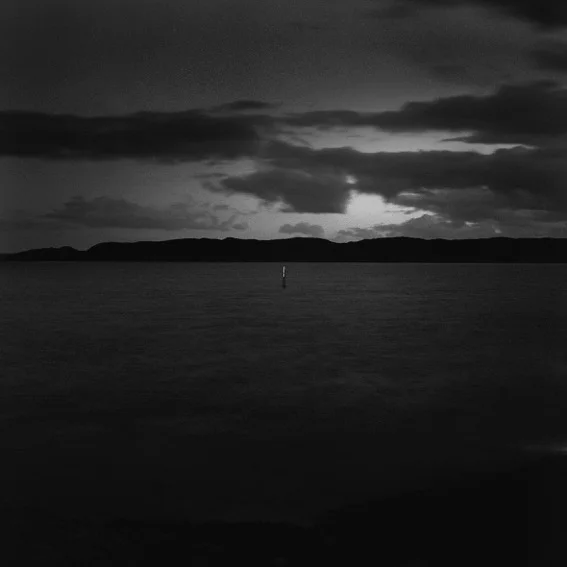
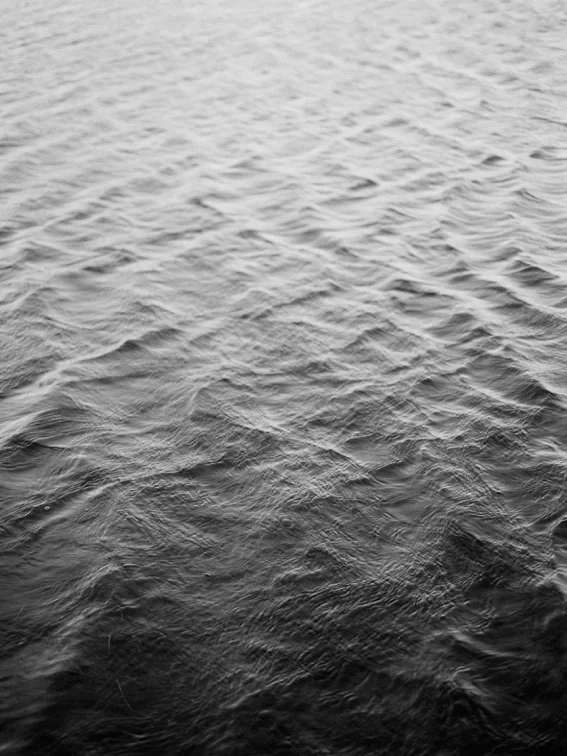
Reconnection and memory are at the core too of Mhairi Law’s The Darkest Dawn, marking the centenary of the Iolaire disaster. Law photographed the treacherous ‘Beasts of Holm’ - a stretch of rocks on which 200 men drowned in 1919 as the HMY Iolaire sank on its return voyage to Stornoway following the end of the First World War. The photographs; made as first light breaks over the Isle of Lewis, are dense and ominous. Law’s depiction of the inky depths slowly reveal a faint needle-like marker in the bay as the new dawn rises - a poignant tribute to a desperate tragedy. Also on show at Stills is Undertow; Frances Scott’s collection of black and white images made during walks around her native Orkney. There is a palpable connection to the land that resonates through Scott’s images, which is complemented by her drawn maps charting her circumnavigation of the Orcadian archipelago. Her drawings trace her meanderings around the islands, recorded in hours and minutes and punctuated with field notes from each journey. Scott’s oblique landscape studies reign in the wilds of the North Sea and Orkney’s rugged coastlines, whilst her drawings offer viewers a direct insight into private moments and memories. The culmination of which results in an evocative lyrical study of place that is as much about poetry and the performative act as it is about photography.
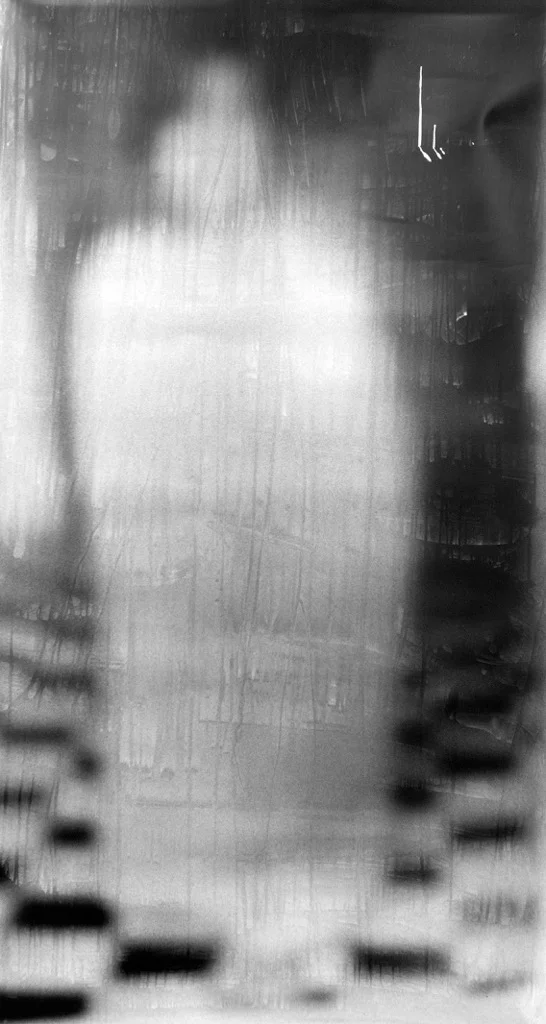
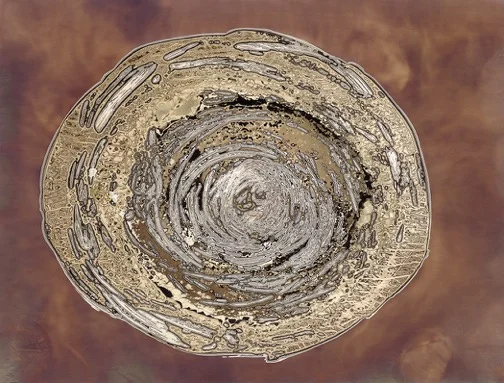
Performance is at the core too of Csilla Kozma’s gothic collection of self-portraits on show at Street Level. Kozma’s unique and ethereal series of Mordançage silver gelatin prints exist at the intersection of photography and printmaking. The performative nature of the images are unmissable, both in terms of subject and process. There is an innate theatricality woven throughout the pictures; as Kozma adopts the roles of both director and muse. With each image the artist reinvents herself as a cast of characters emerge that are haunting and surreal in equal measure. This highly orchestrated series of images highlights a Brechtian approach to picture making, revealing the artifice and mechanics of their production. Morwenna Kearsley’s large scale silver gelatin prints at Stills reveal the method of their making also. Her collection of monumental prints hang from the ceiling, each print bearing the physical traces and watermarks of their makers hand. This sense of touch and process is central to Kearsley’s practice, forcing the viewer to physically navigate the narrow galleries past the hanging prints. They are both breathtaking in scale and captivating in the subtlety of their abstract, spectral depictions. The prints exhibit Kearsley’s painterly approach to picturemaking, pushing photography to its material limits. This experimental approach is shared by fellow exhibitor Brittonie Fletcher who; influenced by her time spent as Stills artist in residence in Orkney, utilises various forms of photographic processes. Fletcher’s smorgasbord of approaches range from traditional silver gelatin prints and C-Types to hand coated papers and chemigrams. Indeed it is her collection of chemigrams that are a particular highlight. These seemingly other-worldly images shift and change as the light-sensitive paper reacts to the gallery spotlights to create a series of organic images in a constant state of flux.
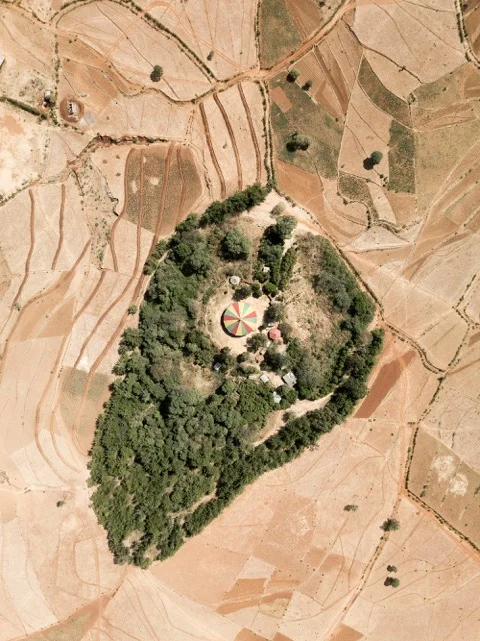
At Street Level, Iain Sarjeant’s series Out of the Ordinary offers a vision of a nation in flux; having spent the last few years making photographs across the length and breadth of Scotland. Sarjeants subject matter ranges from crashed cars in Ayrshire to snow-capped mountains in the Highlands and everything in between. Truly democratic in approach, he photographs the mundane and absurd nature of contemporary Scottish life with vigour. His ongoing collection of photographs serve as a study of the Anthropocene, where even the most remote and scenic areas of the landscape bear the hallmarks of human intervention. Sarjeant’s photographs of the urban and post-industrial fringes are particularly interesting, with a typically Scottish ability to find beauty and black humour in even the most desperate and depressing of locations. Kieran Dodds’ Hierotopia offers viewers an insight into a very different locale; however, as he photographs rural landscapes around Tewahedo Orthodox churches in Northern Ethiopia. His series of subdued portraits and landscape studies offer a startling reminder of the huge ecological toll we are extolling on the planet. Dodds’ aerial photographs showing the stark reality of forest loss around the churches are devastating, as these places of worship stand as the last bastion of survival in an increasingly arid and depleted landscape. It is fitting then that Dodd’s images sit opposite Alex Hall’s series Trauma, which consists of close up studies of scrapped cars. These fragmentary images could be mistaken for abstract aerial landscape studies in their own right. Hall’s images offer us views of deserts of twisted, rusted metal and glaciers of smashed glass and concrete. The juxtaposition of Dodd’s and Hall’s work as you enter the gallery at Stills is immediate and striking.
It is clear from both exhibitions that contemporary photography in Scotland is in rude health. Ambit is not a survey of the photographic status quo but rather a celebration of the strength and diversity of picturemakers in Scotland at present. Conversations and parallels arise naturally between the works and across the venues, with one artist creating the context to better understand the work of the next. That Scotland’s only dedicated photographic galleries can come together to collaborate at a time of ever-increasing competition for audiences and funding is to be commended also; as this can only serve to cement the cultural importance of photography at home and at the same time help raise the profile of contemporary Scottish photography further afield.


Ambit: Photographies from Scotland is on show at Stills until June 2nd and at Street Level Photoworks until June 23rd.
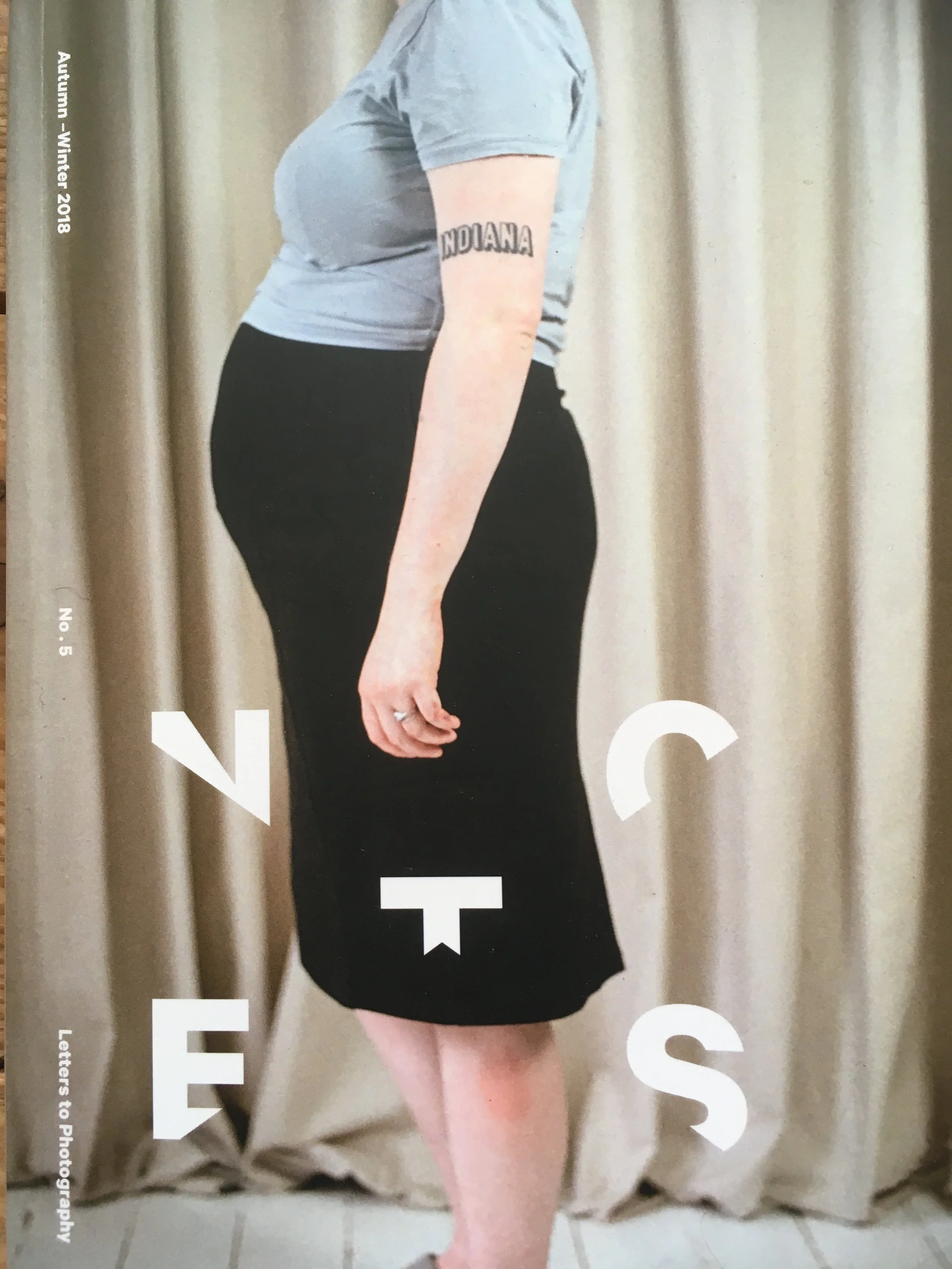
About Control in NOTES Autumn - Winter 2018

About Control

“...And a voice that told her when and where to act, She said I've lost control again.” She’s Lost Control - Joy Division (1979)

About Common Ground is an ongoing photographic investigation by Danish photographer Mads Holm, who has spent the last six years creating a complex visual treatise on the hard controls of advanced capitalism and the invisible power structures at play within the modern world. Holm has been slowly and carefully amassing a series of photographs which coalesce to draw our attention to the often invisible imposition of power structures into our everyday lives, both as individuals and as a society as a whole.

Holm’s photographic mode of enquiry weaves together distinctly different kinds of photographs and sequenced in such a way that his pictures communicate the tensions between what Holm himself describes as the ‘collective consciousness and the influence of advanced capitalism’. In works such as After Control and In Control; both made in 2015, we are presented with two seemingly disparate images that convey succinctly the very essence of the project. The latter image deftly demonstrates Holm’s understanding of anonymous public space as a form of theatre. This, coupled with his ability to render the ensuing drama within a single image, is one of his greatest strengths as a picture maker. One could be forgiven for mistaking this photograph as a tableau vivant, imbued with the same cinematic tensions found in early pictures by Jeff Wall or Gregory Crewdson, but without any of the associated artifice. Indeed throughout About Common Ground, we are confronted with photographs made in anonymous public spaces and sprawling urban landscapes which proves to be fertile ground for a photographer whose eye is trained on the soft power structures that dictate the way we lead our lives.

Holm’s ability to make these kinds of tableau photographs on the street is by no means happenstance. It is the result of years spent honing his skills as a photographer and understanding acutely the types of picture he is seeking to make. Having spent periods studying at Fatamorgana (Copenhagen), International Centre for Photography (New York) and latterly Glasgow School of Art Holm melds together influences from these distinct institutions, both in terms of conceptual approach and technical execution. At the very core of Holm’s practice is the belief in picture-making, combined with a very deliberate and relentless pursuit of the photographs he wishes to make. Holm is not passively waiting for events to unfold in front of his camera, instead, he is actively seeking them out as a means of taking direct action. Rather than merely recording the events around him as a passive bystander Holm is an active participant in many of the photographs he makes. The camera allows the photographer to take an objectively critical approach to the subjects he photographs. The photographs that make About Common Ground are not bound to the conventions of photojournalism or street photography, neither are they tied to the mode of documentary photography. Instead, through his diversity of approach Holm’s photographs exist at the intersection of these photographic traditions. This nascent form of picture making crystallises the primary concerns of Holm’s and grants him the freedom of expression to make a very contemporary record of our time. About Common Ground is ever-changing, ongoing and amorphous in its execution. Through this assimilation of images, the viewer is confronted with an attack of photography that raises increasingly complex questions about the ways and means in which our everyday lives are controlled.

As with many artists, Holm uses his camera as a means to understand the world around him. A number of works explore the seemingly expressive yet tightly controlled tropes of cosplay and furry fandom, two subcultures that seem to espouse creativity and self-expression yet conform to a series of distinctly codified cliches. Holm’s photographs derive from a genuine interest in understanding these modes of alternative self-expression rather than exploiting them as a source of derision and ridicule. John Portman (2017), which depicts a young woman crossing the street dressed as Harley Quinn from the Batman franchise is reminiscent of the work of Philip Lorca diCorcia’s Streetwork series and portraits of LA street hustlers, sharing with them a sense of being visually monumental yet anonymous. Holm’s interest in these fringe subcultures suggests something of a wider narrative at play within About Common Ground - the ways in which we self-identify and in turn self-censor ourselves, another example of the soft control at play within the collective groupthink of advanced capitalism.

When looking the multifarious types of photographs that make up About Common Ground there is a persistent sense that Holm is navigating the fine line between control and chaos, such as the case in Test II (2017), where the visually absurd nature of the image belies the underpinning tension of its subject matter. However, this sinister feeling of impending chaos is addressed explicitly in a series of photographs made at Schnöggersburg, a state of the art urban warfare training facility in northern Germany. Holm spent many years thinking of Schnöggersburg, an artificial city being built near Altmark to train the German Armed Forces soldiers in contemporary urban warfare. Early presentations of the About Common Ground featured texts and information relating to the complex in lieu of access to photograph the site directly. It wasn’t until 2016 that Holm began photographing here, shortly after the first phase of building was completed. The fabricated city will comprise of over 16 km of road infrastructure, including a four-lane expressway and several bridges that span the artificial river EISER. Due for completion in 2020, the city incorporates every urban theatre of war imaginable, including an expansive network of sewage tunnels, high rise buildings, industrial units, suburban residential neighborhoods and religious buildings; including a mosque, synagogue, and church. The compound will span 6km2 and will contain over 500 buildings, easily the most advanced simulated city infrastructure in Europe. Holm’s surreal photographs of this tightly controlled artificial city form a secondary strand of photographs called Barrier Operation, an ongoing, parallel photographic investigation that exists within About Common Ground. The banal, grey dirge of concrete buildings that Holm photographs belie the sinister nature of their use. There is a deep-rooted pathos inherent within these studies. That such a costly structure can be built at a time when many of these same NATO countries are closing their borders to tens of thousands of refugees; fleeing exactly the kinds of conflict Schnöggersburg is used to train for, is a damning an indictment of the power structures at play throughout Holm’s photographs.

With each new exhibition, Holm adapts and amends the photographs in the sequence, drawing upon an ever-increasing body of work, his approach to exhibiting the work is as diverse as his approach to making the images. Through the deft juxtaposition of images; made over a number years and across numerous contrasting locations, it becomes clear that Holm is an internationalist in his outlook, both politically and artistically. His work demonstrates a democratic, all-encompassing approach to picture-making, melding intimate photographs with objective field studies and incidental encounters on the street. This non-hierarchical approach extends to the presentation of the work too, changing and evolving each time it is exhibited. This allows Holm to create new connections between the works on show whilst creating a new context for a body of work that is continually in flux. About Common Ground is a contemporary record of our time, through Holm’s images the tensions of modern life are writ large. Whilst his images do not offer any alternative answers, by illuminating upon the complex and often hidden power structures at play in our everyday lives Holm’s photographs offer us hope that change is possible, if only we care to seek it out.

Mediating History in Studies in SSHoP Studies in Photography 2017 Journal (Edition I)

Frank McElhinney: Mediating History

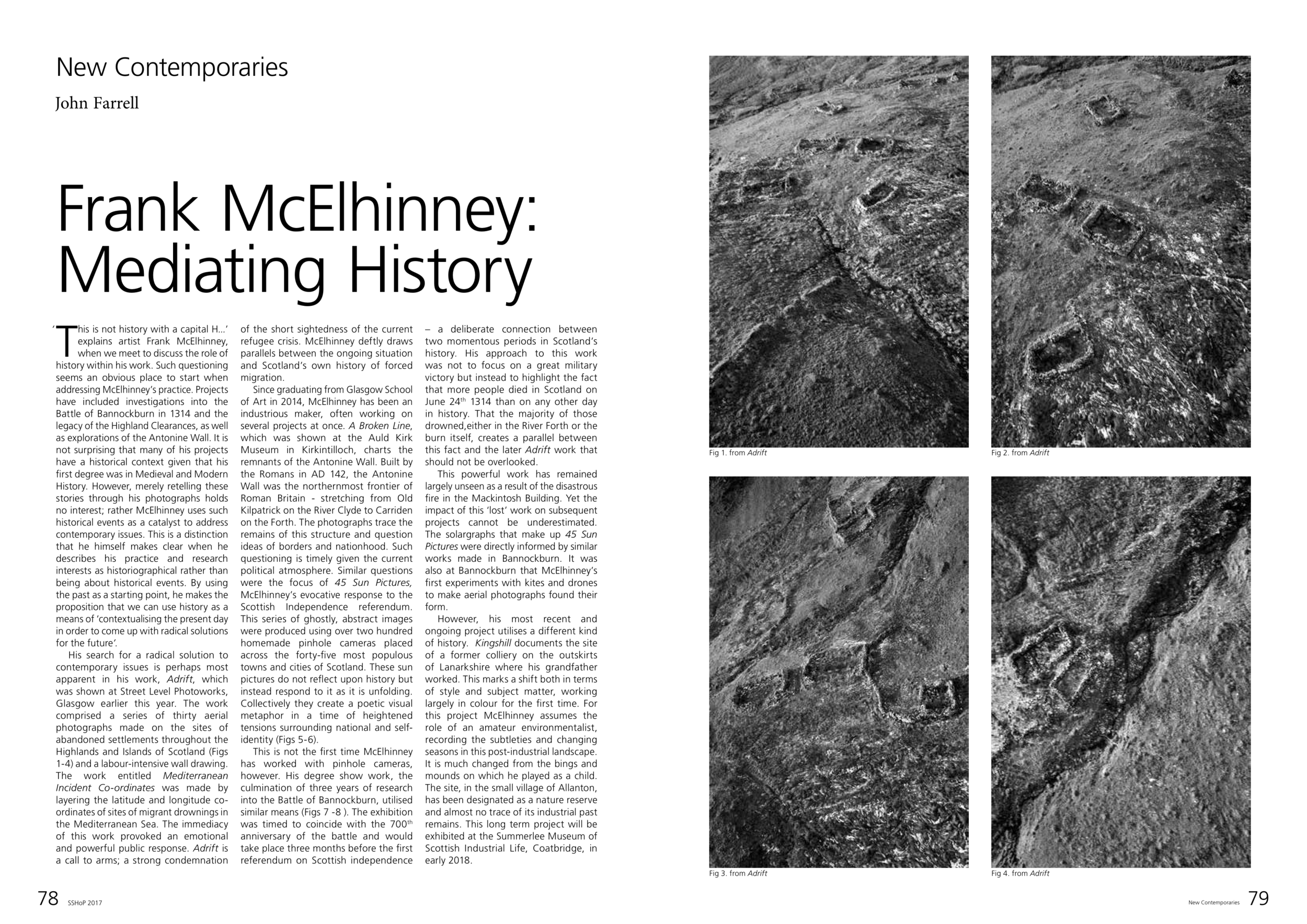
‘This is not history with a capital H...’ explains artist Frank McElhinney when we meet to discuss the role of history within his work. Such questioning seems an obvious place to start when addressing McElhinney’s practice. Projects have included investigations into the Battle of Bannockburn in 1314 and the legacy of the Highland clearances, as well as explorations of the Antonine Wall. It is unsurprising that many of his projects have a historical context given that his first degree was in Medieval and Modern History. However, merely retelling these stories through his photographs holds no interest; rather McElhinney uses such historical events as a catalyst to address contemporary issues. This is a distinction that he himself makes clear when he describes his practice and research interests as historiographical rather than being about historical events. By using the past as a starting point, he makes the proposition that we can use history as a means of ‘contextualising the present day in order to come up with radical solutions for the future.’

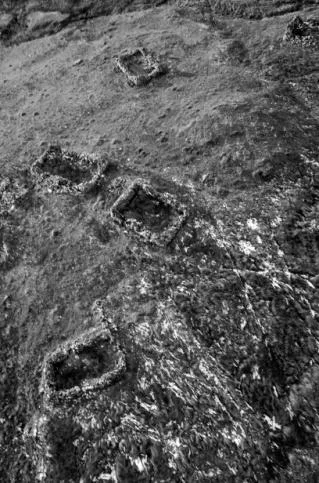
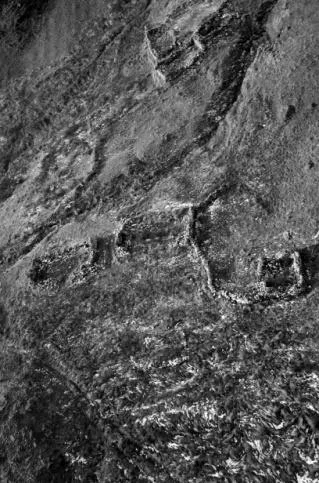
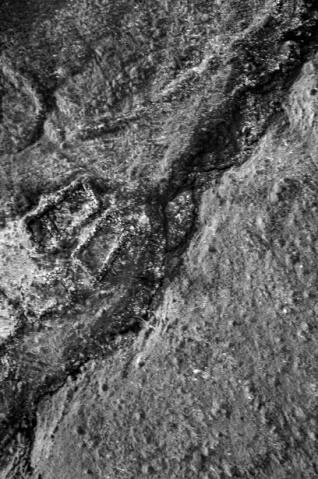
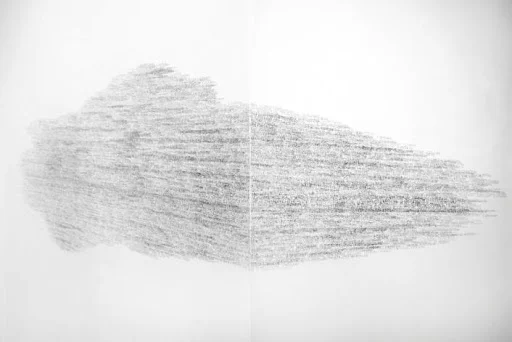
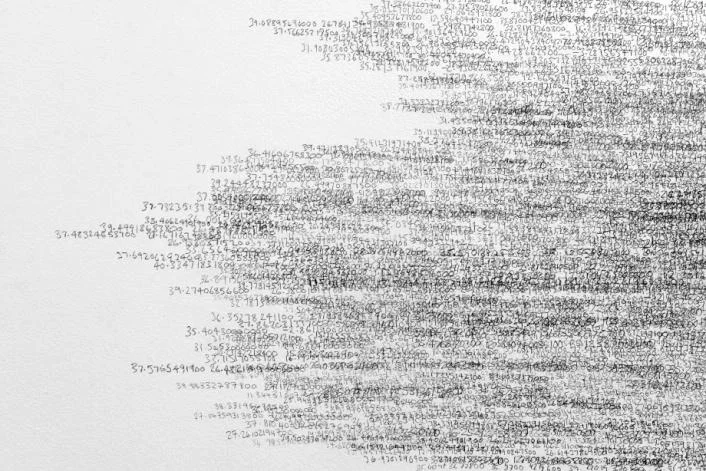
His search for a radical solution to contemporary issues is perhaps most apparent in his work, ‘Adrift’, which was shown at Street Level Photoworks, Glasgow earlier this year. The work comprised a series of thirty aerial photographs made on the sites of abandoned crofts and settlements throughout the Highlands and Islands of Scotland and a labour-intensive wall drawing. The work titled ‘Mediterranean Incident Co-ordinates’, was made by layering the latitude and longitude co-ordinates of sites of migrant drownings in the Mediterranean Sea. The immediacy of this work provoked an emotional and powerful public response. ‘Adrift’ is a call to arms, a strong condemnation of the short sightedness of the current refugee crisis. McElhinney deftly draws parallels between the on-going situation and Scotland’s own forced migratory history.

Quite often history can be used in a conservative or reactionary way. I’m for historical thinking rather revering the past. If you look at the rise of Trump, the fear of immigration - these are alarm bells that warrant looking back.

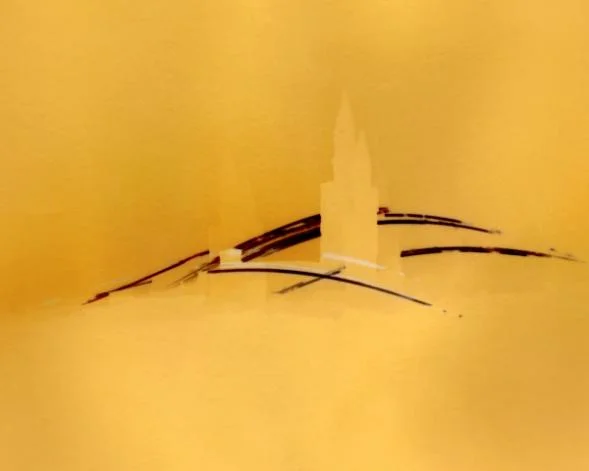
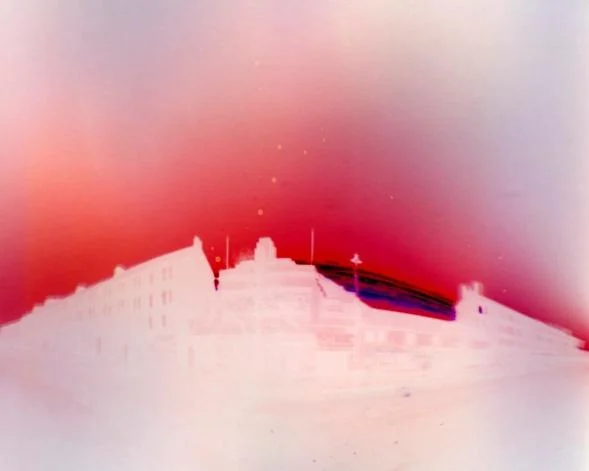
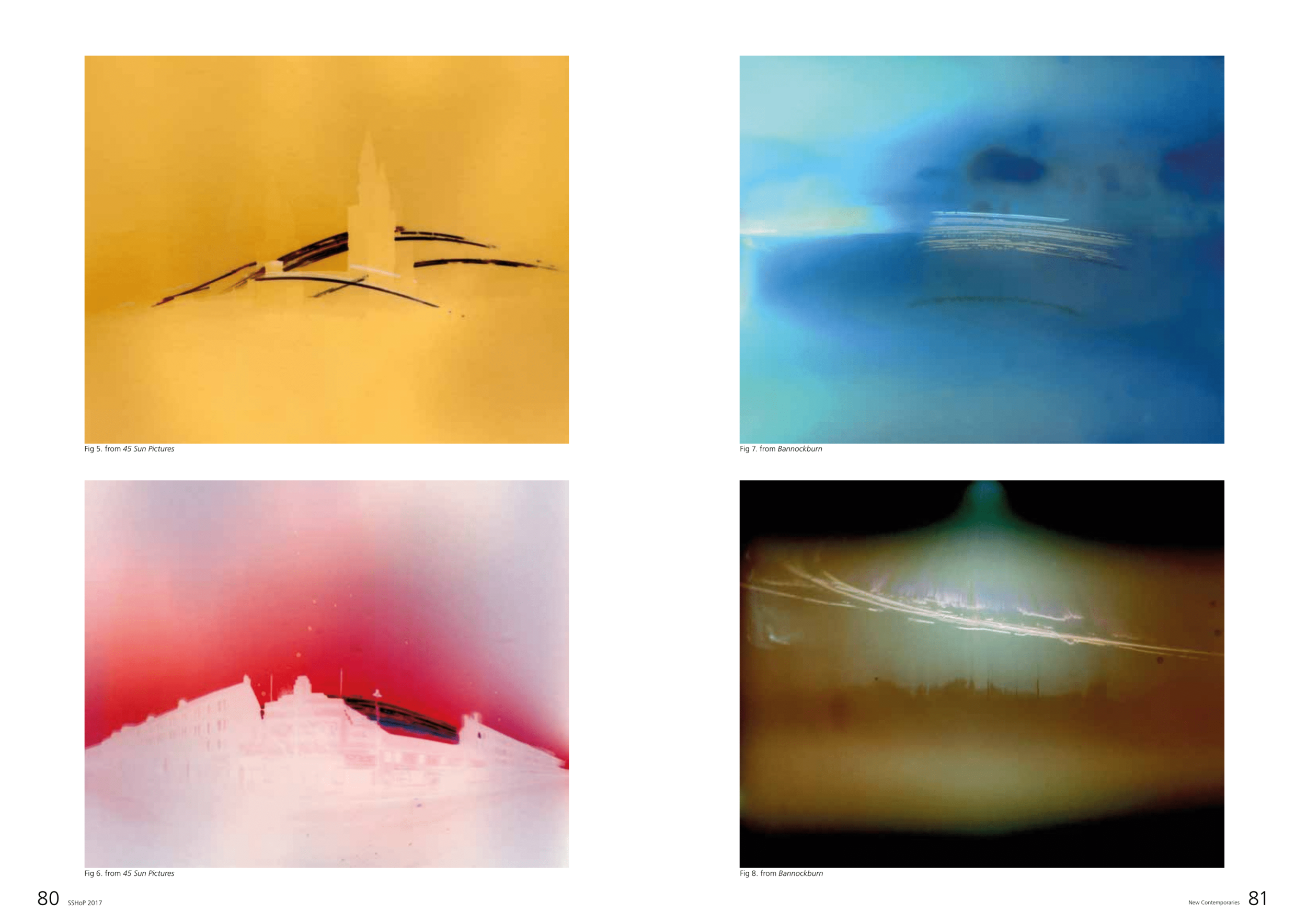
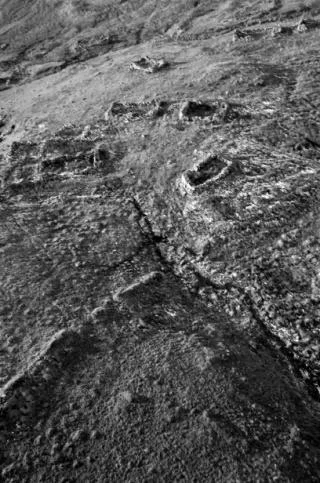
Since graduating from Glasgow School of Art in 2014, McElhinney has been an industrious maker, often working on several projects at once. ‘A Broken Line’, which will be on show at the Auld Kirk Museum in Kirkintilloch, charts the remnants of the Antonine Wall. Built by the Romans in AD 142, the Antonine Wall was the northern-most frontier of Roman Britain - stretching from West Kilpatrick on the River Clyde across to Carriden on the Forth. The photographs trace the remains of this structure and question ideas of borders and nationhood. Such questioning is timely given the current political atmosphere. Similar questions were the focus of 45 Sun Pictures; McElhinney’s evocative response to the Scottish Independence referendum. This series of ghostly, abstract images were produced using over two hundred homemade pinhole cameras placed across the forty-five most populous towns and cities across Scotland. These sun pictures do not reflect upon history but instead respond to it as it is unfolding. Collectively they create a poetic visual metaphor of a time of heightened tensions surrounding national and self-identity.

This is not the first time McElhinney has worked with pinhole cameras, however. His degree show work, the culmination of three years of research into the Battle of Bannockburn, utilised similar means. The exhibition was timed to coincide with the 700th anniversary of the battle and would take place three months before the first referendum on Scottish Independence – a deliberate connection between two momentous periods in Scotland’s history. His approach to this work was not to focus on a great military victory but instead centred on the fact that more people died in Scotland on June 24th 1314 than on any other day in history. That the majority of those drowned creates a parallel between this fact and the later ‘Adrift’ work that should not be overlooked.

The medieval chronicler Barbour describes thousands of people drowning in the River Forth and in the burn itself. He described the burn being so thick with dead bodies and dead horses that you could cross the burn without getting your feet wet.

This powerful work has remained largely unseen as a result of the disastrous fire in the Mackintosh Building. Yet the impact of this ‘lost’ work on subsequent projects cannot be underestimated. The solargraphs that make up 45 Sun Pictures were directly informed by similar works made in Bannockburn. It was also at Bannockburn that McElhinney’s first experiments with kites and drones to make aerial photographs found their form.

However his most recent and on-going project utilises a different kind of history.  ‘Kingshill’ documents the site of a former colliery on the outskirts of Lanarkshire where his Grandfather worked. This marks a shift both in terms of style and subject matter, working largely in colour for the first time. For this project McElhinney assumes the role of an amateur environmentalist, recording the subtleties and changing seasons on this post industrial landscape. It is much changed from the bings and mounds on which he played on as a child. The site, in the small village of Allanton, has been designated as a nature reserve and almost no trace of its industrial past remain. This long term project will be exhibited at the Summerlee Museum of Industrial Life in Coatbridge in early 2018.


Fragments of Living in NOTES Autumn - Winter 2016

Fragments of Living: The Poetry of Robert Frank’s Visual Diaries

In 2013, Michail Mersinis, a tutor in the Fine Art Photography Department at the Glasgow School of Art, sent an email to Robert Frank. The email was written on behalf of Mersinis’ students and requested a ‘donation of words' that could be included in that year’s class exhibition catalogue. In his email, Mersinis made mention of an impassioned discussion that arose during a class lecture the week before. The discussion revolved around Frank’s seminal 1989 work, ‘Hold Still, Keep Going.’ Much to everyone’s surprise, a few weeks later, a reply came for ‘a donation of words:’

Your familiarity with my work suggests that you understand that I have long run out of words. I am left with only photographs now. To satisfy the urgency of your letter and the care that your letter on behalf of your students suggests, please tell them this: Tell them to make work that is close to their heart. It seems to me that no one can expect more than this. I hope this is enough.

Regards,

Robert

Make work that is close to your heart. This simple notion seems to me to be the prevailing spirit that runs throughout most, if not all, of Frank’s work. This is especially evident in a recent series of publications, collectively known as the ‘Visual Diaries’, that Frank has been making in close collaboration with his long time publisher Gerhard Steidl. The most recent, Was Haben Wir Gesehen / What We Have Seen, was published earlier this year. Frank was born in Zurich, Switzerland in 1924 and moved to New York City in 1947 with a portfolio of photographs in the hope to make a new life. He quickly found work at Harper’s Bazaar, which enabled him to travel, first around Peru and Bolivia, followed by a brief return to Europe, where he travelled around Spain and France in 1949. It was in Paris that Frank first met with Robert Delpire, the acclaimed French publisher that would later publish Les Américains in 1958. In New York City Frank struck up friendships with the poet Allen Ginsberg, writers Jack Kerouac, William S. Burroughs, and others of the Beat Generation, which would have a lasting impact on his work. Much like Kerouac and his novel On the Road, Frank is best known for The Americans. This iconoclastic publication’s legacy still reverberates to this day, made almost sixty years ago, it has influenced generations of photographers and artists, people such as Ed Ruscha, Nan Goldin, Duane Michals and JH Engström, to name but a few.

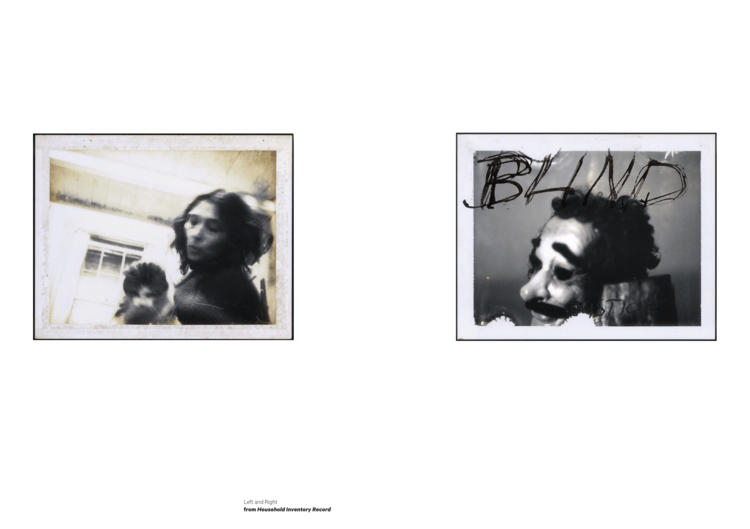
In 1959, Frank put down his Leica and picked up a movie camera and began making films, beginning with Pull My Daisy, a half hour short film written and narrated by Kerouac. Frank would spend the majority of the next decade working on film projects until the publication of his next major bookwork, 1972’s The Lines of my Hand. This book heralded a different kind of revolution in picture making – Frank’s photographs from this period are much more direct, poetic, and deeply personal. Working with a Polaroid camera and pack film, Frank scratched and painted words and phrases over the images, giving the photographs a tactile immediacy and tacit emotional depth. Throughout The Lines of My Hand, we are faced by powerful, singular works in which Frank has taped, nailed, or glued images and text together; filmstrips are combined with still images and printed or pasted together on boards and scrawled over. It is in this work that we see, for the first time, what will become the central themes of Frank's work. His mantra of never looking back is belied by the fact that the first half of the book dredges through the earliest part of his career. The Lines of My Hand is very much a book in two halves--the inclusion of early photographs from London, Paris, Spain, Peru, and iconic images from The Americans in the book’s first half serve only to emphasise the dramatic shift in style and tone of the pictures in the book’s second half.

The post-1970s aesthetic may have been informed not just by the dramatic changes in locale, from Bleecker Street to rural Nova Scotia, but by a number of personal tragedies. The death of his close friend Danny Seymour, with whom Frank collaborated on a number of his early films, had a profound effect on him. This was followed shortly thereafter by the death of Frank’s daughter Andrea in 1974. Andrea, along with his son Pablo, were Frank’s only children born out of his first marriage to artist Mary Frank. Andrea was killed in a plane crash in Guatemala at aged twenty-three, and the wealth of works addressed or dedicated to his daughter is testament to her passing’s impact on Frank. His son Pablo, who had battled with drug addiction and mental illness for many years, took his own life in 1994, aged just forty-three. His relationship with his son was fraught, and a number of film works in which Pablo featured testify to this: The films Conversations in Vermont (1969), Life Dances On (1980), and Home Improvements (1985) clearly demonstrate the difficult, often strained relationship between father and son and the deterioration of Pablo’s mental and physical well-being. The diaristic mode Frank adopted as a film and picture maker at this time is evident throughout his later work.

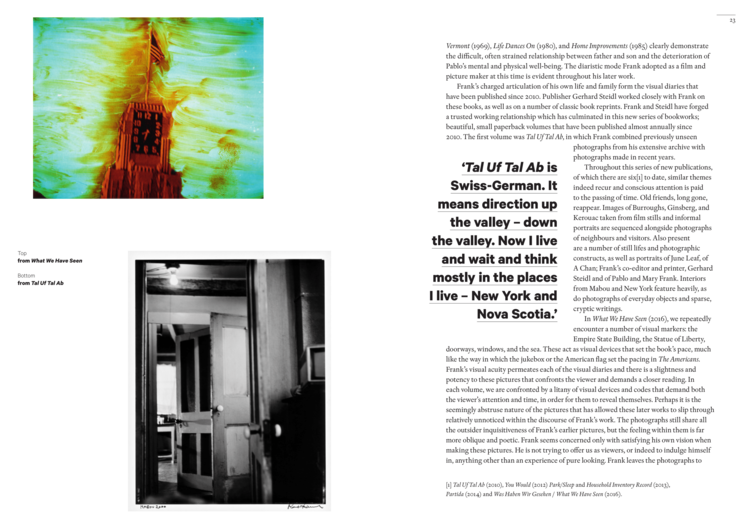
Frank’s charged articulation of his own life and family form the visual diaries that have been published since 2010. Publisher Gerhard Steidl worked closely with Frank on these books, as well as on a number of classic book reprints. Frank and Steidl have forged a trusted working relationship which has culminated in this new series of bookworks; beautiful, small paperback volumes that have been published almost annually since 2010. The first volume was Tal Uf Tal Ab, in which Frank combined previously unseen photographs from his extensive archive with photographs made in recent years.

Tal Uf Tal Ab is Swiss-German. It means direction up the valley – down the valley. Now I live and wait and think mostly in the places I live – New York and Nova Scotia.

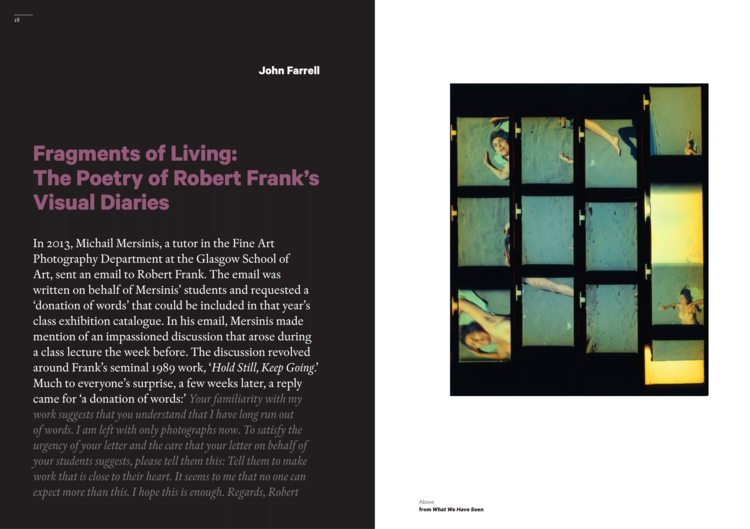
Throughout this series of new publications, of which there are six [1] to date, similar themes indeed recur and conscious attention is paid to the passing of time. Old friends, long gone, reappear. Images of Burroughs, Ginsberg, and Kerouac taken from film stills and informal portraits are sequenced alongside photographs of neighbours and visitors. Also present are a number of still lifes and photographic constructs, as well as portraits of June Leaf, of A Chan; Frank’s co-editor and printer, Gerhard Steidl and of Pablo and Mary Frank. Interiors from Mabou and New York feature heavily, as do photographs of everyday objects and sparse, cryptic writings. In What We Have Seen (2016), we repeatedly encounter a number of visual markers: the Empire State Building, the Statue of Liberty, doorways, windows, and the sea. These act as visual devices that set the book’s pace, much like the way in which the jukebox or the American flag set the pacing in The Americans. Frank’s visual acuity permeates each of the visual diaries and there is a slightness and potency to these pictures that confronts the viewer and demands a closer reading. In each volume, we are confronted by a litany of visual devices and codes that demand both the viewer’s attention and time, in order for them to reveal themselves. Perhaps it is the seemingly abstruse nature of the pictures that has allowed these later works to slip through relatively unnoticed within the discourse of Frank’s work. The photographs still share all the outsider inquisitiveness of Frank’s earlier pictures, but the feeling within them is far more oblique and poetic. Frank seems concerned only with satisfying his own vision when making these pictures. He is not trying to offer us as viewers, or indeed to indulge himself in, anything other than an experience of pure looking. Frank leaves the photographs to speak for themselves. That there is little to no captioning of his work, save for the occasional name of a person or place, reinforces the importance placed on the pure visual experience.

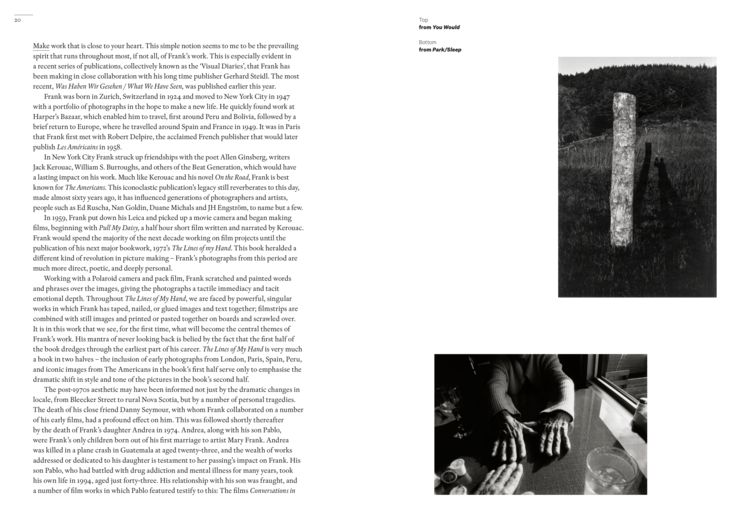
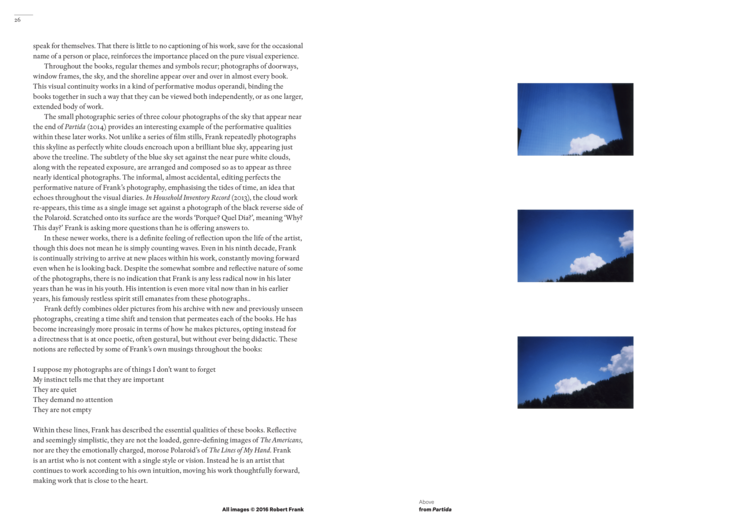
Throughout the books, regular themes and symbols recur; photographs of doorways, window frames, the sky, and the shoreline appear over and over in almost every book. This visual continuity works in a kind of performative modus operandi, binding the books together in such a way that they can be viewed both independently, or as one larger, extended body of work. The small photographic series of three colour photographs of the sky that appear near the end of Partida (2014) provides an interesting example of the performative qualities within these later works. Not unlike a series of film stills, Frank repeatedly photographs this skyline as perfectly white clouds encroach upon a brilliant blue sky, appearing just above the treeline. The subtlety of the blue sky set against the near pure white clouds, along with the repeated exposure, are arranged and composed so as to appear as three nearly identical photographs. The informal, almost accidental, editing perfects the performative nature of Frank’s photography, emphasising the tides of time, an idea that echoes throughout the visual diaries. In Household Inventory Record (2013), the cloud work re-appears, this time as a single image set against a photograph of the black reverse side of the Polaroid. Scratched onto its surface are the words ‘Porque? Quel Dia?’, meaning ‘Why? This day?’ Frank is asking more questions than he is offering answers to.

In these newer works, there is a definite feeling of reflection upon the life of the artist, though this does not mean he is simply counting waves. Even in his ninth decade, Frank is continually striving to arrive at new places within his work, constantly moving forward even when he is looking back. Despite the somewhat sombre and reflective nature of some of the photographs, there is no indication that Frank is any less radical now in his later years than he was in his youth. His intention is even more vital now than in his earlier years, his famously restless spirit still emanates from these photographs..

Frank deftly combines older pictures from his archive with new and previously unseen photographs, creating a time shift and tension that permeates each of the books. He has become increasingly more prosaic in terms of how he makes pictures, opting instead for a directness that is at once poetic, often gestural, but without ever being didactic. These notions are reflected by some of Frank’s own musings throughout the books:

I suppose my photographs are of things I don’t want to forget

My instinct tells me that they are important

They are quiet

They demand no attention

They are not empty

Within these lines, Frank has described the essential qualities of these books. Reflective and seemingly simplistic, they are not the loaded, genre-defining images of The Americans, nor are they the emotionally charged, morose Polaroid’s of The Lines of My Hand. Frank is an artist who is not content with a single style or vision. Instead he is an artist that continues to work according to his own intuition, moving his work thoughtfully forward, making work that is close to the heart.

[1] Tal Uf Tal Ab (2010), You Would (2012) Park/Sleep and Household Inventory Record (2013), Partida (2014) and Was Haben Wir Gesehen / What We Have Seen (2016).

Parade, Hoboken New Jersey in By the Glow of the Jukebox - The Americans List II

#366

I remember the first time I saw a copy of the Americans. In the bowels of a bookshop in rain soaked Glasgow it jumped out the shelves like a bolt of lightning. As soon as I had opened the book I was completely struck by that very first picture. An ashen figure emerges from the shadows – The aftermath of the Second World War and naive optimism of the nuclear age. It is fitting that the window frames the figure as she emerges out of the shadows. Such a simple visual device that is fraught with tension as the deep black frame offsets the pure white window blind. From the centre of the frame the American flag beheads another figure as it bends and contorts in the wind. It’s ripples look almost like it’s on fire – perhaps a nod to McCarthyism and the Cold War. Frank articulates only too well the historic struggles that we now know followed in the years to come - the struggles of the Civil Rights movement, the folly of blind nationalism that led to the horrors of Vietnam. 

Parade – Hoboken, New Jersey - a second bolt of lightning.

I carried it with me for months, devouring it on the train, in class, wherever I could and I would wax lyrical to anyone who would listen – about that photograph in particular. The physicality of the image and its stark, cryptic nature drew me in. It still does, even now. Frank’s photographs seemed somehow to show the future, inevitable yet unknowable at that time. Looking at Parade - Hoboken, New Jersey taught me how to read and I began to see a kind of poetry that only photography can register. The rest of the book flows out of this picture - a bolt of lightning recorded in 35mm film. 

By the Glow of the Jukebox - The Americans List II
p. 127 - 128
Red Hook Editions
2016
Ed. Jason Eskernazi
ISBN 978-0-9841954-2-8